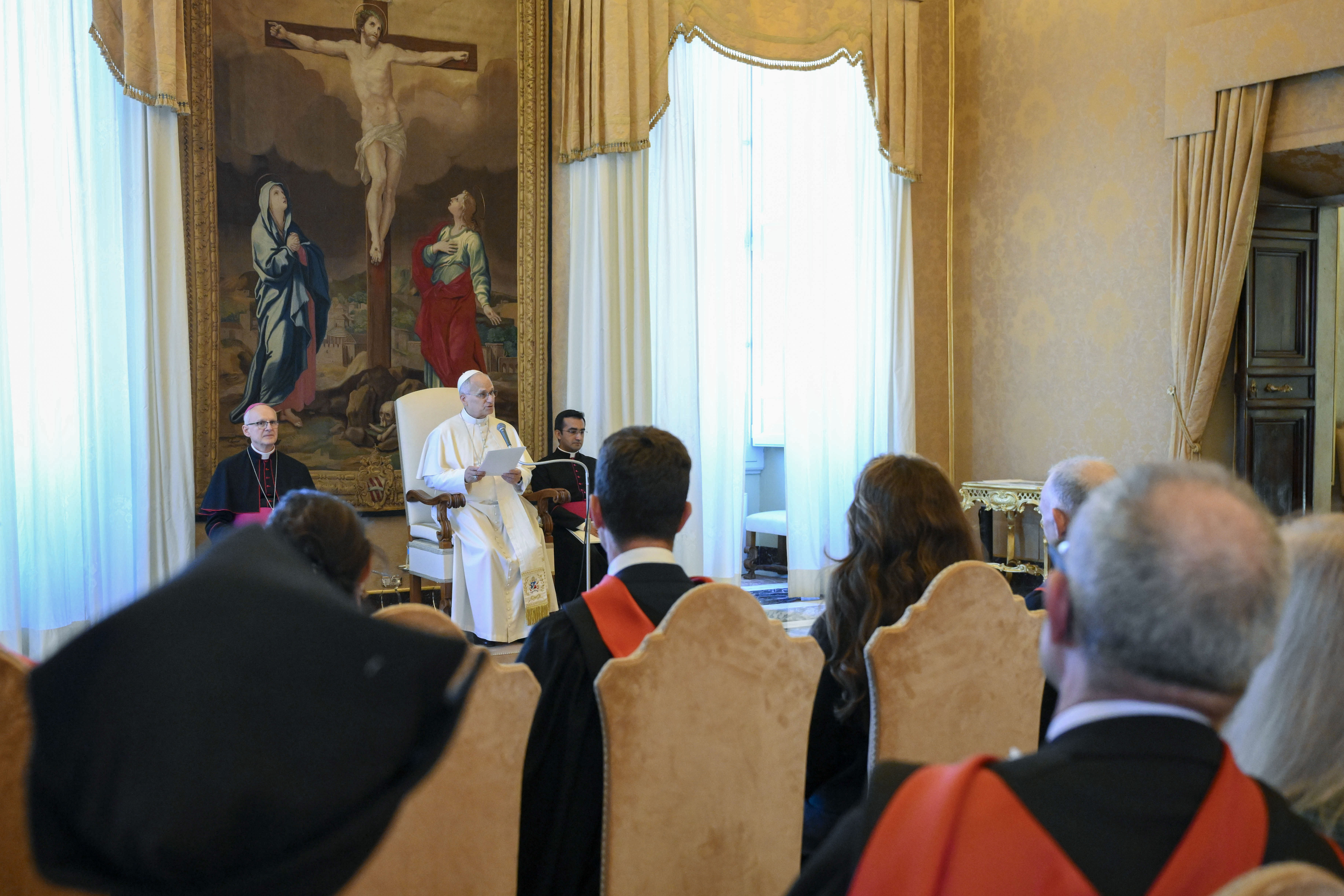
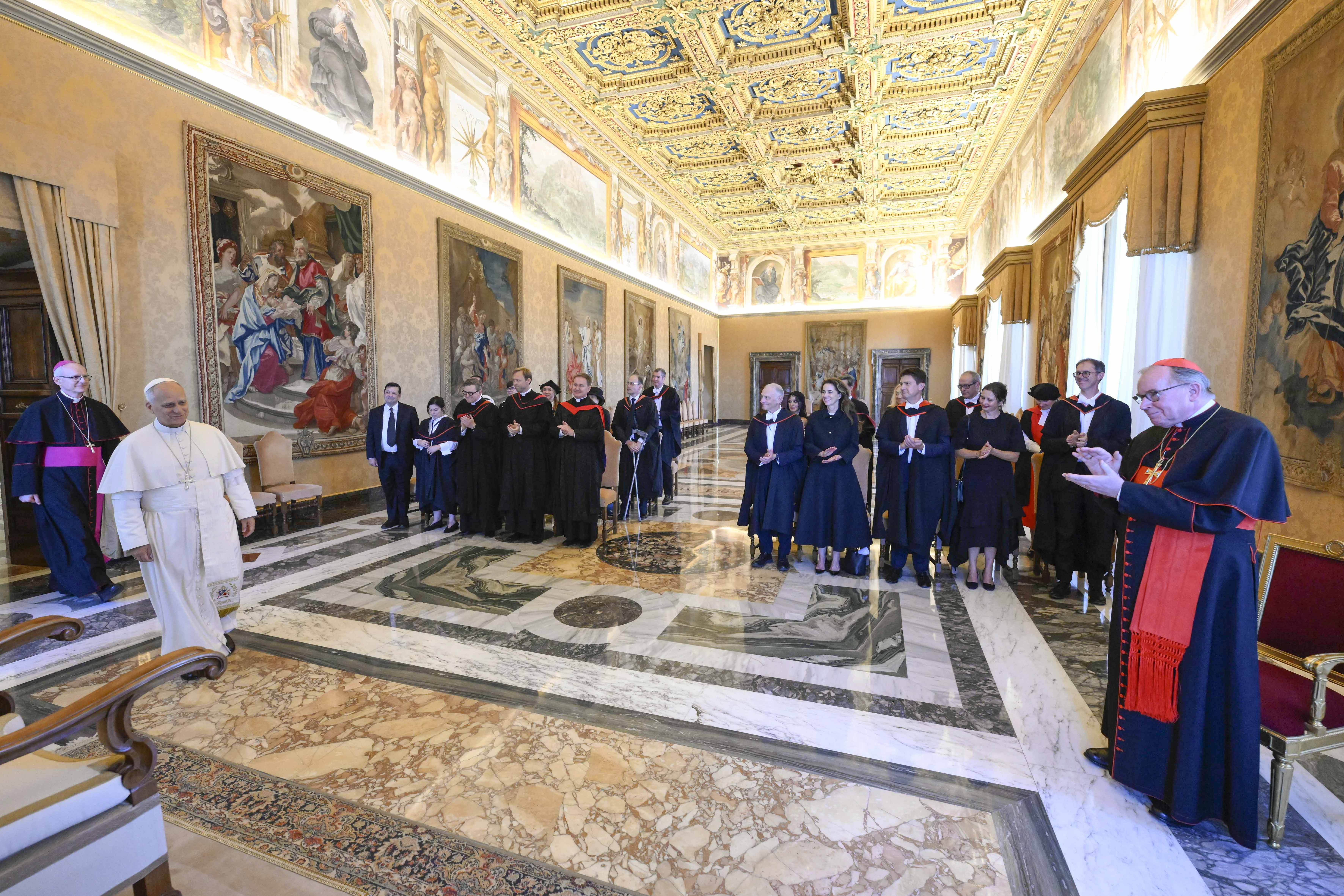
Professor Mark Wynn, Professor Hindy Najman and Professor William Wood from the University of Oxford's Faculty of Theology and Religion were part of an Oriel College delegation that met Pope Leo XIV at the Vatican on Friday 4 September 2026. The audience marked the College's 700th anniversary and the declaration of St John Henry Newman as a Doctor of the Church.
The audience offered an opportunity for members of Oxford's academic community to meet Pope Leo XIV and hear his reflections on the role of universities, the pursuit of knowledge and the relationship between faith and intellectual life.
Professor Hindy Najman reflected on the significance of the occasion and the contemporary relevance of the Pope's remarks:
"It was a great honour to attend a private audience with Pope Leo XIV with a small party from Oriel College in recognition of St John Henry Newman’s declaration as a Doctor of the Church, on the occasion of Oriel’s 700th anniversary. In addition to the rare opportunity to peer behind the curtain of one of the world’s venerable institutions, what struck me was the timeliness and challenging nature of the Pope’s words. He commended to us John Henry Newman’s vision of the university as a forum in which to ‘seek the truth courageously’ in the service, not of job-seeking, but of formation as a whole human with dignity. This was hard in Newman’s time. It seems even harder in an age when AI further fragments knowledge and threatens to remove the dignity deriving from its human production."
Professor Mark Wynn shared his reflections on the Pope's address and his personal encounter with him:
"The occasion for our visit was of course St John Henry Newman's elevation to the status of Doctor of the Church. And I was particularly interested to hear, then, Pope Leo's remarks on what he sees as Newman's contribution to Christian thought. I was most struck by his allusion to Newman's 'integral anthropology' — which I took to be a reference to Newman's development, e.g. in his Grammar of Assent, of the idea of religious faith as a commitment that is quite properly rooted in the person's individual life story, and as an act that is indivisibly cognitive, practical, emotional and perceptual.
Relatedly, I was also struck by Pope Leo himself — by the quietness and under-statedness of his demeanour, and his gentleness in greeting us one by one. He might very well have managed our conversation, putting questions to us, but instead he just held out his hand, and I felt very much that I could have said anything to him — I might even have asked him to say a little more about Newman's anthropology! In the event it felt enough to thank him for receiving us — and marking in this way Newman's importance for the city and University of Oxford, as well as for the life of the universal church."
"It was a tremendous honor to be invited to a private audience with Pope Leo XIV, and I am especially proud that, as far as anyone knows, our delegation from Oriel was the first ever official delegation from the University of Oxford. Meeting this Pope was especially meaningful to me, as an American, and an American who spent ten years in Chicago. When I went up to shake his hand, I really wanted to thank him for the divine support that he has surely called down on our mutual favorite baseball team, the Chicago White Sox. But I kept my dignity, and just said, 'It’s an honor to be here, Your Holiness.'"
The visit also reflected Oxford's distinctive academic environment, in which colleges and faculties provide complementary settings for teaching, research and intellectual exchange. The participation of Faculty academics in the Oriel College delegation highlighted the close relationship between Oxford's colleges and faculties, and how their overlapping activities and connections enrich academic life across the University.