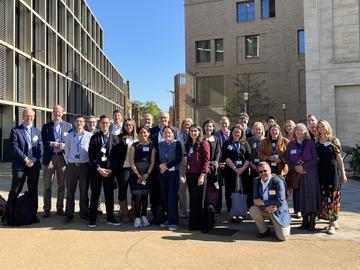
On 23 and 24 April 2026, the Faculty hosted the Ecologies of Care conference, organised by the Oxford Healthcare Values Partnership. The event was a collaboration between the University of Oxford’s Faculty of Theology and Religion (Ed Chan-Stroud and Joshua Hordern), the University of Oxford’s Faculty of Psychiatry (Daniel Maughan) and Duke University’s Faculties of Divinity and Psychiatry (Warren Kinghorn). The conference was possible thanks to the generous support of the McDonald Agape Foundation.
The two days brought together clergy, mental health professionals, academics, and pastoral practitioners to reflect on the nature of care within contemporary church and healthcare contexts. One of the strengths of the conference was the dialogue it established between academics and practitioners. The conference included participants from the Royal College of Psychiatry’s Spirituality and Psychiatry Special Interest Group, the Clergy Support Trust, St Luke’s for Clergy Wellbeing, the Mind and Soul Foundation, the Clergy Wellbeing Covenant Working Group, and Sanctuary Mental Health Ministries.
Learning about Ecologies of Care
The conference began with Norman Wirzba (Duke University) reflecting on the need for ‘ecologies of care’. The term, coined by the conference, was intended to provide an alternative account of care from models dominated by mechanistic language (e.g. input, output, system, breakdown, burnout).
Drawing especially on St Paul’s letters, Susan Eastman (Duke University) and Teresa Morgan (Yale University) began to articulate an alternative account of care. Turning to Paul’s description of the ‘body of Christ’. Here, care is not understood solely as a deficit-response but as an activity integral to all human beings.
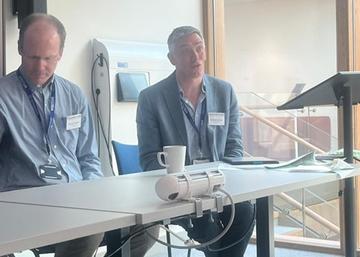
Next Daniel Maughan (University of Oxford) and John Swinton (University of Aberdeen) reflected on the challenge of providing care in both contemporary healthcare settings and in the Church. Participants raised particular concerns about only understanding patients according to diagnostic categories and emphasised the importance of knowing a patient’s story, because the stories we tell about people shape the ways we love.
While recognising the challenges associated with contexts of care, Matt Croasmun (Yale University), Warren Kinghorn (Duke University) and Isabelle Hamley (Ridley Hall) went on to discuss how care might be cultivated despite these challenges. Drawing on the image of Israel in a ‘strange land’ (Psalm 137) and the prophet Jeremiah’s exhortation for Israel to plant gardens in exile (Jeremiah 29:35), speakers discussed how gardens might be cultivated in a strange land. Gardening represented a model of care rooted in cultivation rather than control: nurturing growth patiently, attending to context, listening before acting, and creating conditions in which healing and transformation can emerge. Particularly striking was the discussion of composting as an image for transformation — the possibility that suffering, loss, and even death can become the ground from which new life emerges.
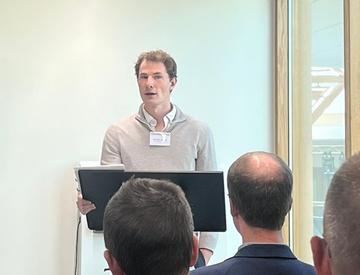
Finally, Joanna Collicutt (University of Oxford) and Ed Chan-Stroud (University of Oxford) reflected on how liturgical and spiritual practices might shape care. In these papers and the breakout discussions which followed, participants discussed how God’s love might ground relationships of care, facilitating healing, trust, and meaning-making. Participants also emphasised the importance of avoiding simplistic theologies, spiritual overreach, or in any sense coercing patients into spiritual practices.
The Afterlife of Ecologies of Care
Mental health professionals and clergy are groups with a huge amount to learn from one another. Despite this, there are few spaces where the two groups can build relationship. Recognising this, we plan to create a research network to facilitate dialogue and knowledge exchange between the two groups.
In addition to the research network, The Journal of Theology and Psychology have agreed to a Special Issued based on the conference proceedings published later next year. This Special Issue will allow us to share the research from the two days with a broader audience.
Alongside these research focused activities, based on discussions begun at the conference a number of participants have started to design and produce practical resource which will directly support ministers and mental health professionals to produce and sustain ecologies of care.